
Case Study: From Success to Legacy: A South Asian Industrialist’s Multi-Generational Business Blueprint
Our client was a wealthy South Asian industrialist who built his fortune in the textile industry. His primary focus eventually shifted from the machinery of the mills to the stewardship of his legacy and the sustainability of the wealth he had created long after he was managing it. His sons were in their 20s, and while they were talented, he was deeply concerned that the wealth he had worked a lifetime to build would not be sustained without a clear, structural foundation.
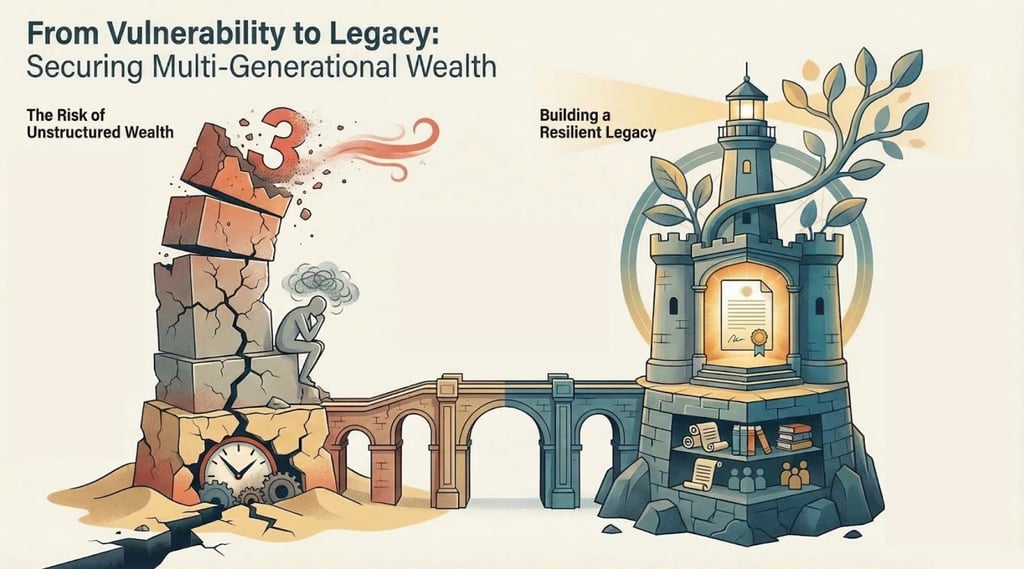
Our client was a wealthy South Asian industrialist who built his fortune in the textile industry. His primary focus eventually shifted from the machinery of the mills to the stewardship of his legacy and the sustainability of the wealth he had created long after he was managing it. His sons were in their 20s, and while they were talented, he was deeply concerned that the wealth he had worked a lifetime to build would not be sustained without a clear, structural foundation. He knew that most family wealth vanishes by the third generation, and with his sons so young, the stakes for a successful transition were incredibly high. We originally started with a detailed research project to determine the characteristics that create sustained multigenerational companies. We analyzed over 100 multigenerational family businesses to discover what worked and what did not. After this, the client decided that he wanted our help to make this research more personal to their business and we help them create an in-depth family constitution.

At the time, the family faced a significant roadblock: they had no formal plan or governance structure with which to manage the future. The founder felt a growing sense of concern, fearing that the opportunity he created to provide for his family’s economic prosperity in future generations might not be realized because the family lacked insight into how to perpetuate wealth over generations.
We stepped in not just as valuation experts, but as strategic guides to help bridge this gap. This particular client wasn’t interested in broad guidance. They insisted on evidence-based best practices. We showed the family that we understood their objectives and mindset by asking them hard questions they hadn't considered and providing data-driven research to complement their answers. Our firm's authority is rooted in an empirical approach—we ask many questions and study risk—and they valued a partner who analyzed the evidence rather than relying on instinct and general principles.
Our initial collaboration lasted 18 months, during which we identified the behaviors of families who successfully maintained wealth across centuries, such as the Mercks and Rothschilds. We also studied the longevity of insurance companies, some of the oldest institutions in the world, to understand their investment behavior, and determine how their longevity might be replicated in a non-insurance company environment. We didn't just hand over a report; we worked side-by-side with the founder and his sons to build a Family Constitution, a prescriptive, detailed, and comprehensive manual that serves as a decision-making guide grounded in their specific values and goals. The final product was printed and bound as a family resource.
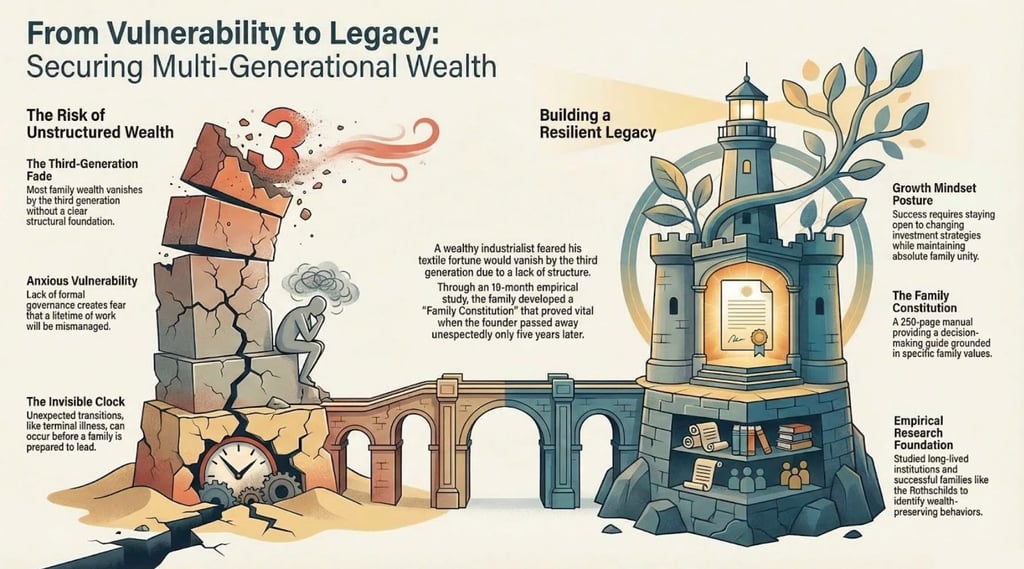
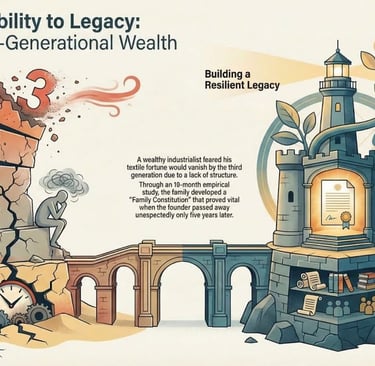
The transformation was put to the ultimate test much sooner than anyone expected. The founder sadly passed away unexpectedly, five years after our project, his sons were not left in a vacuum of uncertainty and grief. They were ready. They still rely on the rules and principles established in the family constitution to make decisions consistent with their father's vision and with the empirically-based best practices we helped them discover. Because the heirs adhered to the guidance in the constitution we helped them develop, the family’s wealth engine continues to thrive today.
One of the founder's final wishes was for us to remain involved as a close advisor for his sons whenever they faced a high-stakes challenge. Today, the family remains close, and the legacy is secure, moving from a state of potential vulnerability to one of structured, resilient prosperity.
Can we help you go from potential vulnerability to resilient prosperity? Please connect with us today ask@highscorestrategies.com.
Terms and Conditions
Portugal Address
Prontos Impact Village
Largo Heróis da Naulila nº 16, Loja 22
2500-107 Caldas Da Rainha, Leiria
Portugal
United States Address
1441 Woodmont Ln NW, Suite 2028
Atlanta GA 30318
United States Of America